
Updated June 3, 2026

Written by
HassamOn 3 June 2026, Google launched two new reports inside Search Console: the Generative AI Performance Report for Search and the Generative AI Performance Report for Discover. For anyone running SEO or managing a website in the UK, these are the reports the industry has been asking for since AI Overviews started displacing traditional search clicks in 2024.
The honest summary: this is progress. It is also, in its current form, half a measurement solution.
There is no click data. There is no query data. What Google has given site owners is impressions only, which tells you how often your pages appeared inside AI features, but not whether anyone clicked through, and not what they were searching for when your page appeared. For UK businesses trying to understand whether their AI search visibility is actually driving traffic and leads, the most important questions remain unanswered.
What is here is still worth understanding clearly, because the reports do tell you something useful, and because of a second announcement that landed the same morning that most coverage is underplaying. We will cover both.
What the Reports Actually Show
There are two separate reports, not one. They measure different things and count impressions differently. Understanding both matters.
Report One: Generative AI Performance in Search
This report covers your pages’ visibility inside AI Mode and AI Overviews in Google Search. It shows:
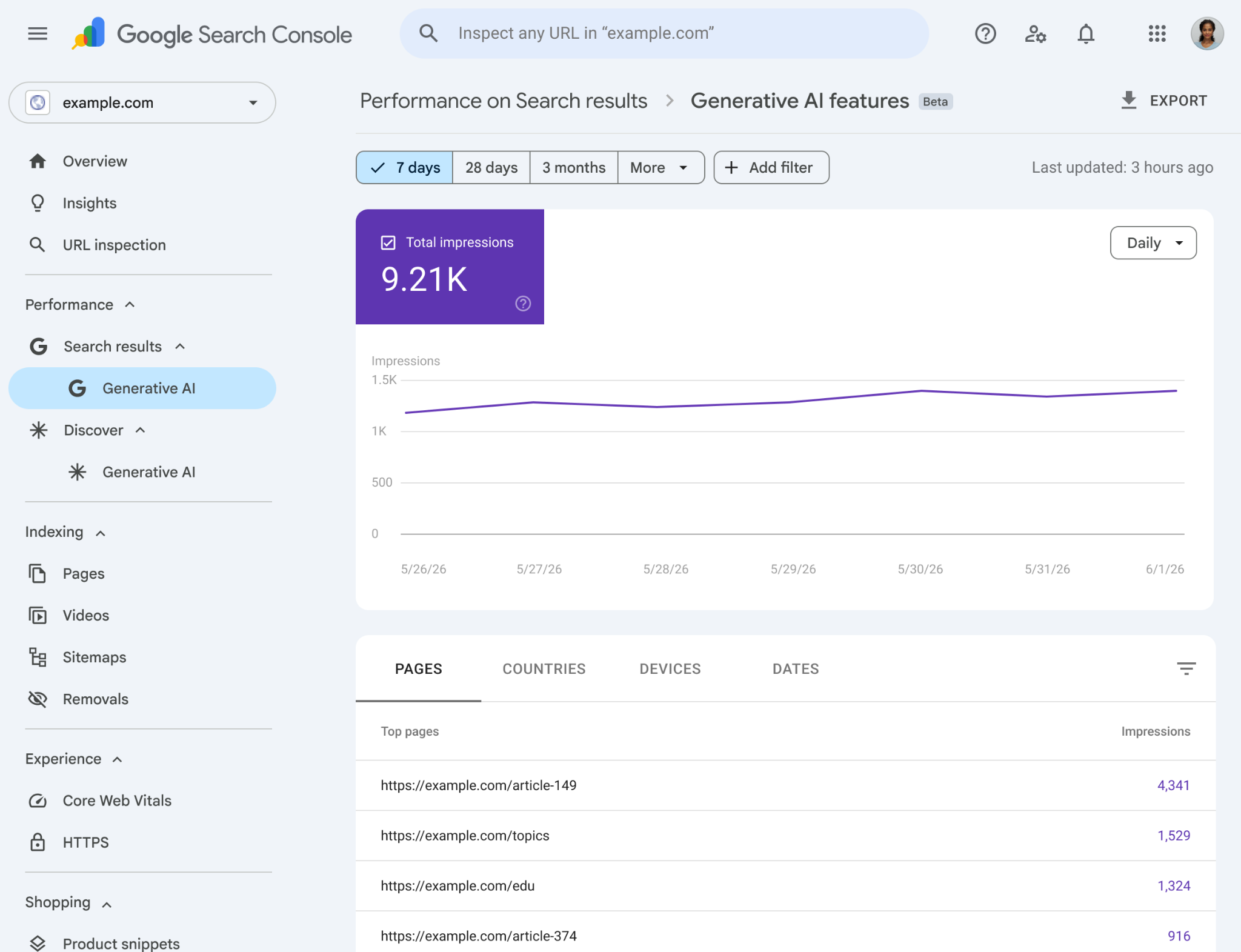
Credit: Image By Google
- Impressions: how many times any URL from your site appeared inside an AI Mode or AI Overview result
- Pages: which specific URLs are appearing in AI features
- Devices: desktop versus mobile breakdown of those impressions
- Countries: where the searches generating those impressions originated
- Dates: daily, weekly, and monthly granularity going back to 18 May 2026
One important technical detail on how impressions are counted here: if two of your URLs appear in the same AI Mode response to a single query, that counts as one impression, not two. Google is counting the query interaction, not the individual URL appearances.
What it does not show: no click data, no CTR, no average position, no query-level data. You cannot see which searches are triggering your content to appear in AI features.
Report Two: Generative AI Performance in Discover
This report covers your pages’ visibility inside AI features within Google Discover, which is the algorithmically personalised content feed served on mobile and in the Google app. It shows:
- Impressions: how often your URLs were surfaced by AI features in the Discover feed
- Pages: which URLs are being surfaced
- Countries: where content was viewed, not where a query originated, because Discover does not involve keyword searches
Discover notably does not include a device breakdown, which is a gap given Discover is almost entirely mobile.
The impression counting here works differently from the Search report. In Discover, each URL counts separately, so if two of your pages appear in one Discover session, that counts as two impressions. And critically, an impression is only counted once the user has actually scrolled that URL into view. Appearing in the feed but not being seen does not count.
Two reports. Different impression counting methods. Different country definitions. Neither includes click data. These are not interchangeable numbers and should not be compared directly.
What is not in either report
The absence of query data is the most significant limitation. For the Search report specifically, you can see that your pages appeared in AI Mode or AI Overviews, but you cannot see which searches triggered those appearances. You cannot do keyword-level analysis, cannot identify which queries you rank well for in AI features versus standard search, and cannot map AI impressions to search intent.
Bing Webmaster Tools, which launched its own AI Performance report in February 2026, is ahead on this. The Bing report shows which specific URLs are cited in AI answers, which queries triggered those citations, and how citation activity changes over time. Google’s current implementation does not match that depth.
Google has confirmed it is working on additional metrics and will introduce them over time. There is no timeline.
The Bigger Story That Launched the Same Morning
The AI performance reports were not the only thing Google announced on 3 June. The same day, the UK’s Competition and Markets Authority issued its first conduct requirement against Google under the Digital Markets, Competition and Consumers Act 2024, and Google responded by launching a second feature inside Search Console: an opt-out toggle.
The CMA requirement
The CMA has designated Google as having ‘strategic market status’ in UK search. This gives the regulator power to impose conduct requirements directly. The requirement issued on 3 June compels Google to:
- Allow UK publishers to opt out of having their content used to ground AI search features, including AI Overviews and AI Mode, without losing visibility in standard search results
- Allow separate opt-out from having content used to fine-tune Google’s internal AI models
- Apply both controls at the domain level and the individual page level
- Properly attribute publisher content in AI responses with clear links back to the source
- File compliance reports every six months during the first year
The CMA has described this as a world first. No other regulator has achieved a requirement of this type against Google’s search business. Google has nine months to implement the full set of requirements, though some controls are already being tested.
The opt-out toggle: what it actually does
Through Search Console, UK site owners who have access to the current test can flip a toggle to exclude their domain or specific pages from appearing in AI Overviews, AI Mode, and AI features in Discover. Google has confirmed that opting out will not affect a site’s ranking in standard search results.
The toggle takes effect from 17 June 2026 for sites currently in the test group. It is being rolled out to a subset of UK website owners before a broader global launch.
The strategic question this raises: should you opt out? For most UK businesses trying to grow through search, the answer is almost certainly no. AI features are an additional visibility surface. Opting out removes your content from those surfaces without recovering the clicks those impressions may or may not have been generating. The opt-out makes more sense for publishers whose primary concern is content licensing and negotiating revenue from Google, not for businesses using search as a growth channel.
How to Actually Use These Reports if You Have Access
The reports are rolling out to a subset of UK sites first. If they are not yet in your Search Console, they will be. When they do appear, here is how to interpret them without overclaiming what the data shows.
Use impressions as a directional visibility signal, not a traffic metric
Impressions in the AI report tell you how often Google is choosing to surface your content inside AI features. High impressions mean Google considers your content relevant and credible enough to include in AI-generated answers. Zero or very low impressions suggest your content is not being pulled into AI responses for your topic area.
This is useful diagnostic information. It tells you whether your content strategy is generating AI visibility, even if it cannot yet tell you whether that visibility is sending traffic.
Compare your AI impressions to your standard search impressions
The AI report data is also included inside your main Performance report, it is just separated out here for clarity. Pull both views and compare the ratio. If you have significant AI impressions but your overall traffic has not grown proportionally, that is evidence of the zero-click pattern, where users get their answer from the AI feature without clicking through to your site.
This is one of the central tensions for publishers and content-led businesses right now, and it is directly why the CMA issued its requirement. For businesses where the goal is generating qualified leads and enquiries, the question is whether AI visibility translates into brand recognition and eventual direct contact, even without the click.
Use the pages report to audit your AI-visible content
The pages breakdown shows you which specific URLs are appearing in AI features. This is strategically valuable even without click data. It tells you:
- Which of your content topics Google considers authoritative enough to pull into AI answers
- Whether your service or product pages are appearing in AI features, or only your blog content
- Where you have AI visibility gaps, topic areas you cover where none of your pages appear
At HDSQUARES, we have been auditing clients’ AI visibility as part of our SEO strategy work by cross-referencing manual AI searches with GSC data. This report makes that process faster and more scalable.
Track the trend, not the absolute number
The data only goes back to 18 May 2026. You have two weeks of history at most right now. The absolute impression numbers will not tell you much in isolation. What matters is whether the trend is up, flat, or declining as you publish new content, adjust your strategy, or make technical changes to your site.
Set a monthly review cadence. Compare your AI impressions trend against your standard search impressions trend. Divergence between the two, especially if standard search clicks drop while AI impressions grow, is the signal that your content is being consumed inside AI features rather than generating traffic to your site.
What This Changes About Your AI Search Strategy
The launch of these reports does not change what good AI search optimisation looks like. It gives you better data to evaluate whether what you are doing is working.
The factors that determine whether your content appears in AI Overviews and AI Mode are the same ones we have been building toward in our growth marketing and SEO work: clear topic authority, structured content that answers specific questions directly, credible authorship signals, schema markup, and consistent brand presence across third-party sources.
What the reports add is accountability. Before 3 June, you could optimise for AI search visibility without knowing whether it was working. Now you can see whether your pages are appearing in AI features and track whether your changes move that number.
The measurement gap is half-closed. Impressions are visible. Clicks and queries are not. The businesses that will get ahead in AI search right now are the ones building the right content architecture while their competitors wait for perfect data before acting.
The UK is currently the only market with both the new reports and the opt-out toggle. That is not a coincidence. It is a direct result of the CMA’s conduct requirements. The global rollout will follow, but UK businesses have early access to data that their international competitors do not have yet. That is a brief but real window.
If you want to understand what your current AI search impressions mean for your strategy, or where your content has visibility gaps that these reports would expose, speak to the HDSQUARES team. We work inside these tools daily and can tell you what the numbers mean for your specific situation.
Frequently Asked Questions
What is the Generative AI Performance Report in Google Search Console?
The Generative AI Performance Report is a new section inside Google Search Console, launched on 3 June 2026, that shows how often your website’s pages appear inside Google’s AI-powered search features. There are two separate reports: one covering AI Mode and AI Overviews in Google Search, and one covering AI features in Google Discover. Both reports currently show impressions only, with a breakdown by page, country, and date. The Search report also includes a device breakdown.
Does the Google Search Console AI report show clicks?
No. The current Generative AI Performance Reports show impressions only. There is no click data, no click-through rate, and no average position data. You can see how often your pages appeared in AI features, but not how many users clicked through to your site from those appearances. Google has said it will introduce additional metrics over time but has not given a timeline.
What is the difference between the Search and Discover AI reports in Search Console?
The Search report covers impressions from AI Mode and AI Overviews in Google’s search results. The Discover report covers impressions from AI features in Google Discover, the personalised content feed. They count impressions differently: the Search report counts one impression per AI response regardless of how many of your URLs appear in it, while the Discover report counts each URL individually. They also define countries differently: the Search report uses the location where the query was made, while the Discover report uses the location where the content was viewed.
Why is the Google AI Search Console report only available in the UK first?
The UK launch is directly connected to a conduct requirement issued by the UK Competition and Markets Authority on 3 June 2026. The CMA designated Google as having strategic market status in UK search and required Google to give publishers more control over how their content is used in AI features. The AI performance reports and the opt-out toggle are Google’s initial response to that requirement. A global rollout is expected but no date has been confirmed.
What is the Google Search Console AI opt-out toggle?
The opt-out toggle is a new control inside Google Search Console that allows UK website owners to exclude their content from appearing in Google’s AI search features, including AI Overviews, AI Mode, and AI features in Discover. Opting out removes your pages from AI-generated answers but does not affect your visibility in standard Google search results. It also separately allows you to opt out of having your content used to fine-tune Google’s AI models. The toggle takes effect for the current test group from 17 June 2026.
Should I opt out of Google’s AI features?
For most businesses using search as a growth channel, opting out is unlikely to be the right decision. AI features provide additional visibility surface area, and opting out removes your content from those surfaces without any clear traffic benefit in return. The opt-out is more relevant for publishers primarily concerned with content licensing negotiations or those experiencing significant traffic loss attributable to AI Overviews replacing clicks. Before opting out, review your AI impressions data against your standard search click trends to understand whether the AI visibility is genuinely cannibalising traffic or adding to it.
How does Google’s AI Search Console report compare to Bing’s equivalent?
Microsoft launched an AI Performance report in Bing Webmaster Tools in February 2026. The Bing report is more detailed: it shows which specific URLs are cited in AI answers, which queries triggered those citations, and how citation activity changes over time. The Bing report is also available globally. Google’s current report shows impressions only with no query data or click data and is currently limited to a subset of UK site owners. Google’s version is a meaningful starting point but is behind Bing’s on analytical depth at launch.
HDSQUARES is a Glasgow-based AI development and growth marketing agency. We run SEO and AI search optimisation strategies for UK businesses. If your Search Console now shows the Generative AI Performance Reports and you want help interpreting what the numbers mean for your strategy, we can help.


